




Our Knowledge Center
The Knowledge Center is a comprehensive repository of information dedicated to the imaging industry. It offers a wide array of expert articles, cutting-edge research, and practical guides on the latest advancements in imaging technology. Designed for healthcare professionals, this resource hub provides valuable insights and updates to help you stay informed and excel in your field.

 White Papers
Solving a global thrive for medical imaging
In developed countries, the distribution of modern technologies is remarkably variable1, and for many of them it is even the case that demand is running ahead of supply. In low- and middle-income countries, the problem is much more significant – these technologies are unaffordable. Not only the demand-to-offer ratio is much higher, but for some countries the offer is quasi-inexistent. According to WHO (World Health Organization), 41 out of 135 countries still do not have a single computed tomography machine2. Approximately 70% of humanity does not yet have access to medical imaging. The challenges of booming demands for imaging, its considerable costs, even for developed nations, and its impossible costs for developing countries, and the shortage of expert personnel demand a novel approach. These challenges are what Nanox is aiming to solve. Via its groundbreaking Cold-Cathode technology3, Nanox’s vision is to democratize medical imaging by offering accessible, low-cost, and high-quality imaging devices based on a pay per use business model. Through its innovative MSaaS business model, Nanox aims to provide affordable Medical Scanning As A Service to all parts of the world, and in a wide range of medical sites.
The Nanox Ecosystem – solving a multi-faceted challenge
As detailed above, there is a thriving need for medical imaging technologies that Nanox aims to fulfill at a global scale. Bringing a complete solution of medical imaging to an extensive range of heterogeneous countries and medical facilities constitutes a real challenge and requires an adapted ‘ecosystem’ of Nanox technology. First, and most importantly, the broad and quick deployment of thousands of Nanox.ARC systems requires an ecosystem that allows their management and control. Nanox is developing an MSaaS business model to address this challenge. Nanox is the owner of the machines and therefore must continuously trace those systems to allow efficient management. This fleet management is an essential part of the Nanox deployment strategy.
Secondly, the deployment of Nanox.ARC systems to such a broad and heterogeneous range of countries and medical facilities constitutes a real challenge. Many of these countries are developing countries with a real shortage of radiologists (especially those specializing in more advanced modalities), and when there are radiologists in these countries, they are primarily located in urban areas. These factors might be associated with significant delays in patient care and misdiagnosis with increased morbidity and mortality. The broad deployment of ARC systems cannot depend on qualified local personnel for providing a diagnosis. Nanox ecosystem needs to allow the patient scan data to be sent to radiologists in a remote location for diagnosis.
Another priority is to keep the device as low-cost as possible. Minimizing onboard computational hardware by exporting it to a remote centralized processing service could also reduce this cost. The shortage of chips faced by the world today, especially of high-end chip-sets needed for intensive computational tasks further amplifies the need for lowering the system’s costs. The expenditure of adding Tomosynthesis capabilities to general radiography systems led to a limited worldwide adoption of Tomosynthesis by the most funded imaging centers only. Since the Nanox.ARC is primarily a Tomosynthesis system and not a General Radiography system, the production costs can be lower. The unique per use business model of Nanox moreover allows to avoid the capital expense barrier and free up cash flow.
Finally, Nanox needs a system to generate and manage all billing in different corners of the world. Again, due to its MSaaS model, the Nanox ecosystem shall allow all scanning activity to be easily monitored and managed, translating the latter into billing elements. In summary, to achieve its vision, Nanox needs a system that can answer the following challenges:
- Quick upscale
Nanox wishes to deploy thousands of designs worldwide in a limited time frame. - Shortage of radiologists
The systems will deploy in many countries that do not have the radiology capacity to diagnose patient data. - Minimizing costs
Nanox, via its unique per use business model, aims to keep its systems as affordable as possible for medical sites around the globe. - Billing
Nanox needs its billing system to be compatible with its MSaaS model.
The Nanox.CLOUD
The cloud developed by Nanox is designed to answer the challenges discussed above and complete the Nanox ecosystem through a harmonious implementation. Nanox.CLOUD is a companion software of the ARC systems, planned to connect to and interact with Nanox.ARC and other parties that are involved in the lifecycle of Nanox services. It is not a stand-alone system but an integral part of a more extensive operation, enabling Nanox MSaaS business model.
To answer the questions detailed earlier, Nanox.CLOUD wears ‘multiple hats’. First, Nanox.CLOUD is a major component of Nanox medical data processing and management. Not only does Nanox.CLOUD serve as a connection between scanning and diagnosis, but it collects all the data from the ARC fleet, and distributes the data transformed into a 3D tomosynthesis image to different platforms to implement tele-radiology. As stated, Nanox.CLOUD then operates as a link between the three ‘medical actors’ along the process: the medical site where the scan is performed, the radiologist who provides the diagnosis and finally the referring physician who receives the 3D tomosynthesis images together with the diagnosis. A patient suffering from chest pain could thus very well be scanned in a hospital in the suburbs of Abuja, Nigeria, in the morning, for example, and be diagnosed on the same day by a radiologist located in a remote location by using Nanox tele-radiology.
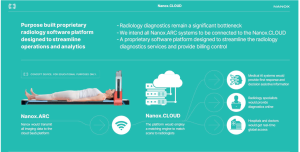
Through this model, Nanox builds a radiologist network through which the continuous education on Tomosynthesis can be promoted and enhance its adoption within the medical community.
In addition, Nanox.CLOUD is also responsible for Nanox.ARC fleet management. A cloud-based platform will serve as a tool for managing the thousands of ARC systems deployed globally. Not only Nanox.CLOUD will enable listing and traceability of all ARC units, but it will also continuously receive updates and statuses of the device’s state and activity. Obtaining this information empowers Nanox.CLOUD – it can offer preventive maintenance services, avoid defective machines, and maximize uptime of the systems. In its MSaaS business model, Nanox wishes to build a pay-per-scan pricing structure – Nanox.CLOUD will be the conductor of all the financial operations that follow the scanning; by doing so, it monitors all scan activities, allowing to elaborate business intelligence (cost control, revenue comparison per fleet/area, business data analytics, etc.). The inputs received from the Nanox.ARC systems are, therefore, a real added-value for business development, on one side, and for optimizing the usage of the ARCs, on the other; both made possible by Nanox.CLOUD design.
Embracing the digital transformation of healthcare
Given the increasing demand for medical imaging and the constant overload hospitals worldwide are dealing with, it is commonly accepted that staffing problems are unlikely to be overcome by sufficiently significant increases in investment in training and employment of radiologists, technicians, and support workers. The role of Tele-Radiology, cloud-based systems and Artificial Intelligence (AI) is undeniably expected to play an increasingly important part in solving this problem. This increase in imaging demand goes together with a constant rise in the medical imaging data volume. The latter is not used effectively today and often becomes a liability rather than an asset. The challenge facing each medical service organization is to store, retrieve, and fully apply the massive image data. As a result, there has been an enormous shift in the generation, consumption, storage and sharing of healthcare data in the last years; and the cloud is the preferred solution in that regard. According to the West Monroe Partner’s report, 35 percent of healthcare organizations surveyed held more than 50 percent of data or infrastructure in the cloud4. Healthcare proved to be farthest along with cloud adoption when compared to other industries. Driven by the importance of delivering timely diagnosis and treatment for patients, and not just quality healthcare, the recent global crisis accelerated this transition even more. The next step for the healthcare industry is to leverage the cloud to facilitate secure and efficient communication among patients, doctors, hospitals, and payers. Nanox, for which the implementation of a medical cloud is essential and indissociable from its MSaaS model, clearly embraces this digital revolution. Nanox specifically thinks its technological design to answer the challenges of our new era through its technological ecosystem and, in particular, Nanox.CLOUD is preparing for a quick upscale and managing and receiving a large volume of medical data.
Nanox.CLOUD horizons
The enormous volume of medical imaging data expected to be received by Nanox.CLOUD is an excellent opportunity to develop many new or yet sub-explored medical solutions. With the abundant amounts of data flowing into Nanox ecosystem and Nanox.CLOUD, Nanox shall be able to learn at a fast pace and develop AI solutions that may reduce medical errors. Algorithms allowing to find early or predictive signs of chronic conditions in patients for which these are still unknown could be used. Coronary arterial disease, stroke and osteoporosis are examples of applications where population health screening and predictive analytics could be used5 6.
However, this meaningful amount of data is not always a chance and can be a risk factor for patients from an individual perspective. Indeed, if not followed by an adapted number of radiologists, the data queue can quickly translate into a bottleneck effect, increasing time-to-diagnosis – the Nanox.CLOUD could use in the future AI algorithms based on deep-learning and population health, as discussed above, to triage the studies to mitigate the impact of this scenario. Instead of uploading studies for diagnosis in a ‘first-in-first-out’ method, AI tools, trained by the large amount of data collected by Nanox systems, could be used to analyze all studies in the queue and prioritize cases where clinical findings are detected.
In the further future, which may not be so far from now, AI algorithms could therefore become a decision support tool used on a daily basis among radiologists which will enhance their productivity and read throughput time significantly. Finally, in a similar way, Nanox.CLOUD will collect essential data on the usage of Nanox.ARC machines from Radiology Technicians and Operators. Usage analytics will first allow to optimize the system’s usability and, more specifically, of the operator Nanox.ARC interface, as for every application. Moreover, by analyzing at a global scale the protocols used per body region or the editing of default protocol parameters, for example, Nanox will gain insights into the usage of Nanox.ARC systems. Comparisons can be made per geographical area or per medical site type, allowing one to better know and understand the end-users and the local populations concerned, and have customer-tailored services.
1“Statista,” [Online]. Available: https://www.statista.com/statistics/266539/distribution-of-equipment-for-computer-tomography/.
2”W. H. Organization. [Online]. Available: https://apps.who.int/gho/data/node.main.510.
3”N. W. Papers, “Hot Vs. Cold Cathode Technology Overview,” 2020.
4“W. Monroe, “Technology is Transforming Everything: Businesses Struggle To Change With It,” 2018.
5”N. Dagan et al., “Automated opportunistic osteoporotic fracture risk assessment using computed tomography scans to aid in FRAX underutilization,” Nature Medicine, pp. 77-82, 2020.
6”A. Stemmer et al., “Using machine learning algorithms to review computed tomography scans and assess risk for cardiovascular disease: Retrospective analysis from the National Lung Screening Trial (NLST),” PLOS One, 2020.
* Nanox.ARC was cleared by the FDA for MSK imaging as adjunct to X- Ray. Other applications will be available in other markets per local regulatory approvals.
 10 Minutes reading


 Client portal